Thu, Mar 5, 2026
When Does an Interactive Sales Presentation Actually Make Sense?

We’ve all seen it play out. A rep comes back from a meeting that went well, except the prospect didn’t quite follow the offer, asked three questions the deck couldn’t answer, and asked to “receive something they could share internally.”
The document never got opened.
That’s usually where the idea of an interactive presentation starts to surface.
It’s a fair question to ask. But before investing time in building something more ambitious, it’s worth being clear about when it actually makes a difference, and when it’s just extra work.
When it makes sense
Your product is hard to explain in a linear way
Some products have a simple story: here’s what it does, here’s the price, here’s why it’s better. A slide deck handles that fine.
But if your product has multiple configurations, serves different client profiles, or involves a process that’s genuinely hard to visualize, linearity works against you.
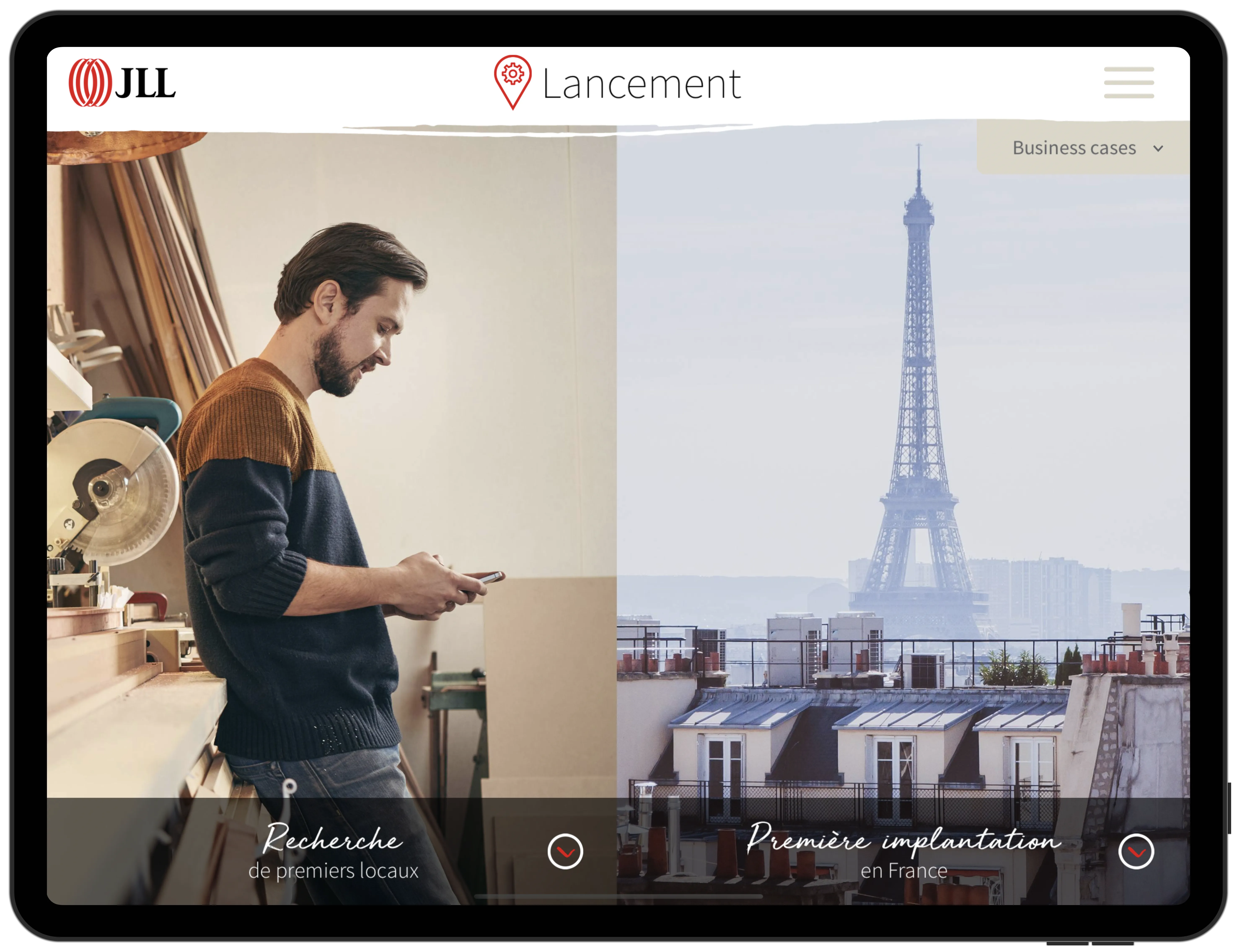
JLL, the real estate services company, had this problem. Their reps walked into meetings with a generic deck while every client had a different set of concerns.
Their solution: a tool structured around client questions, that lets reps navigate to what’s relevant for the person in front of them. The meeting becomes a real conversation rather than a presentation.
The same logic applies to technical products. Here, a complex industrial process (the heating system of a building) becomes immediately readable through an interactive diagram. No slide could do the same job.
You cover multiple product lines or sectors
When you sell across several product ranges or serve different industries, a linear deck forces you to make a call: show everything (and risk losing the room) or pre-select (and risk missing what matters).
Hub One sells a wide range of solutions to very different industries. With a linear presentation, there’s no good option: too much to show at once, too risky to cut.
Their solution: organize the entire offer as a navigable wheel. Reps go straight to what’s relevant for each client, without losing the thread or apologizing for “skipping a few slides.”

That’s also where richer media formats start to earn their place. An interactive presentation can embed videos and 3D models directly in the flow: an animated demo to show how a product works, a 3D model to explore it in detail, a customer video to back up a claim. None of that is possible with static slides.
Your sales cycle is long enough to justify the investment
Building an interactive presentation takes more upfront effort than updating a PowerPoint. If you’re selling something that closes in one call, that investment rarely pays off.
But if your cycle involves multiple meetings, multiple stakeholders, or a document that gets forwarded around after the meeting, the format starts to justify itself. A link your prospect can explore on their own, that looks and feels like something they’d want to share internally, does work your rep can’t.
Your reps are inconsistent
Every sales team has a range. Some reps can walk into a room and improvise their way through any conversation. Others stick to the script because the script is what they know.
When a presentation is well structured, with clear paths, answers to common objections built in, the right content surfaced at the right moment, it raises the floor. The less experienced rep starts to perform closer to the best one. Not because the tool is magic, but because it’s well designed.
If consistency across your team is a real problem, that’s a concrete argument for investing in the format.
You’re selling to a room, not a person
When there are multiple stakeholders in a meeting (technical buyers, financial buyers, end users), a linear deck forces you to choose who you’re talking to. You either lose someone or slow everyone else down.
An interactive format lets you move. Jump to the technical detail when the IT person leans forward. Pull up the ROI view when the CFO asks a question. Stay in control of the room without being locked into a sequence.
When it probably doesn’t make sense
It’s worth being direct here.
If your sales cycle is short and transactional, the upfront investment won’t pay off. If your product story is genuinely simple, adding interactivity doesn’t make it clearer: it just adds layers.
And honestly, if your team won’t use it, nothing else matters. We’ve seen companies build polished interactive tools that lived on a server somewhere because the sales team defaulted back to the PDF they already knew. Adoption is a real problem, and it’s worth thinking about before you build.
A few honest signals that it’s probably not the right fit right now:
- Your deals close in one or two touchpoints
- Your product line is narrow and your pitch doesn’t change much by customer
- Your reps are already strong and consistent
- You don’t have someone who can own the tool and keep it updated
None of that means never. It just means the timing or context isn’t right.
So, should you build one?
Here’s a simple way to think about it. If several of these situations ring true (complex product, long cycle, decks that get shared internally, uneven reps, mixed rooms with multiple stakeholders), it’s worth exploring seriously.
If only one applies, or none, you’ll probably get more out of improving what you already have. A good deck that gets used beats a polished interactive experience that never gets opened.
The useful question isn’t “would interactivity be cool here?” It’s “what is the current format consistently failing to do?”
One last thing
The best interactive presentations we’ve seen weren’t built because someone wanted something impressive. They were built because a specific frustration was identified.
If you have a frustration, that’s where to start. Figure out what the current format is failing to do. Then build something that solves that problem.
The interactivity is just the means. The meeting is the point.